Introduction
Imagine you are ready to leave for work, but your car key suddenly snaps while you are unlocking the door or turning the ignition. You now have a broken key in your hand and another piece stuck inside the lock. It is an annoying situation, especially when you have somewhere important to be.
For drivers in Parramatta, this problem can happen at home, in a workplace car park or while running errands around the local area. Your first instinct might be to grab a pair of pliers or try pulling the broken piece out with a small tool.
But is that really a good idea?
The answer depends on how the key has broken and where the remaining piece is lodged. Sometimes, a visible fragment can be removed without difficulty. In other situations, attempting to extract it yourself can damage the lock and make the repair more complicated.
In this guide, Car Keys Locksmith explains what you should do when a car key breaks, which DIY methods are worth avoiding, and when professional car key extraction is the better option.
What Does Car Key Extraction Mean?
Car key extraction is the process of removing a broken section of a key from a vehicle’s lock or ignition without causing unnecessary damage to the surrounding mechanism.
Although it sounds straightforward, the job can be more difficult than expected. A key may snap near the opening of the lock, break further inside the cylinder or become lodged at an awkward angle.
The location of the broken piece makes a difference.
For example, a fragment sticking out of a car door lock may be easier to access than one that has broken completely inside an ignition barrel. Some modern vehicles also use electronic keys, transponder chips and remote locking systems, which may require additional work if the key itself is damaged.
The main goal of car key extraction is to remove the trapped metal safely and determine whether the lock and key system can still operate properly.
Can You Remove a Broken Car Key Yourself?
You may be able to remove a broken car key yourself if a reasonable section of the metal blade is visible and can be gripped without forcing it.
However, when the broken piece is hidden inside the lock, DIY removal becomes much more difficult. Trying several tools without knowing how the lock is constructed can push the fragment further inside or damage the internal components.
Before attempting removal, look at the situation carefully.
When DIY Removal May Be Possible
If part of the key is clearly sticking out, you might be able to grip the exposed section with a suitable tool and pull it straight out gently.
Only consider this if the fragment is easy to access and moves without resistance. Do not twist it, bend it or apply excessive pressure.
If the piece does not come out with minimal effort, stop. Continuing to pull may cause the remaining section to snap again.
When You Should Call an Automotive Locksmith
Professional assistance is generally the safer choice when:
- The broken key is completely inside the ignition.
- The fragment is not visible or cannot be gripped securely.
- The key broke while you were turning it.
- The ignition or door lock was already difficult to operate.
- A previous attempt has pushed the fragment further into the lock.
- The vehicle uses a specialised key or locking system that you are unfamiliar with.
For drivers in Parramatta, arranging an assessment can help avoid turning a small broken-key problem into a more expensive lock repair.
Five Mistakes to Avoid When a Car Key Breaks
When a key snaps unexpectedly, it is tempting to try anything that might get the vehicle working again. Unfortunately, some common household methods can cause additional damage.
1. Using Superglue to Pull Out the Key
Attaching another object to the broken key with superglue might sound like an easy solution. The problem is that adhesive can spread into the lock and affect its internal components.
If the glue bonds to the wrong surface, removing the fragment may become considerably harder.
It is best to keep adhesives away from the keyway.
2. Pushing a Screwdriver Inside the Lock
A screwdriver is not designed for broken key extraction. Inserting one into a narrow keyway can scratch internal parts, jam the fragment or damage the mechanism.
Even if the tool appears to fit, that does not mean it is suitable for the job.
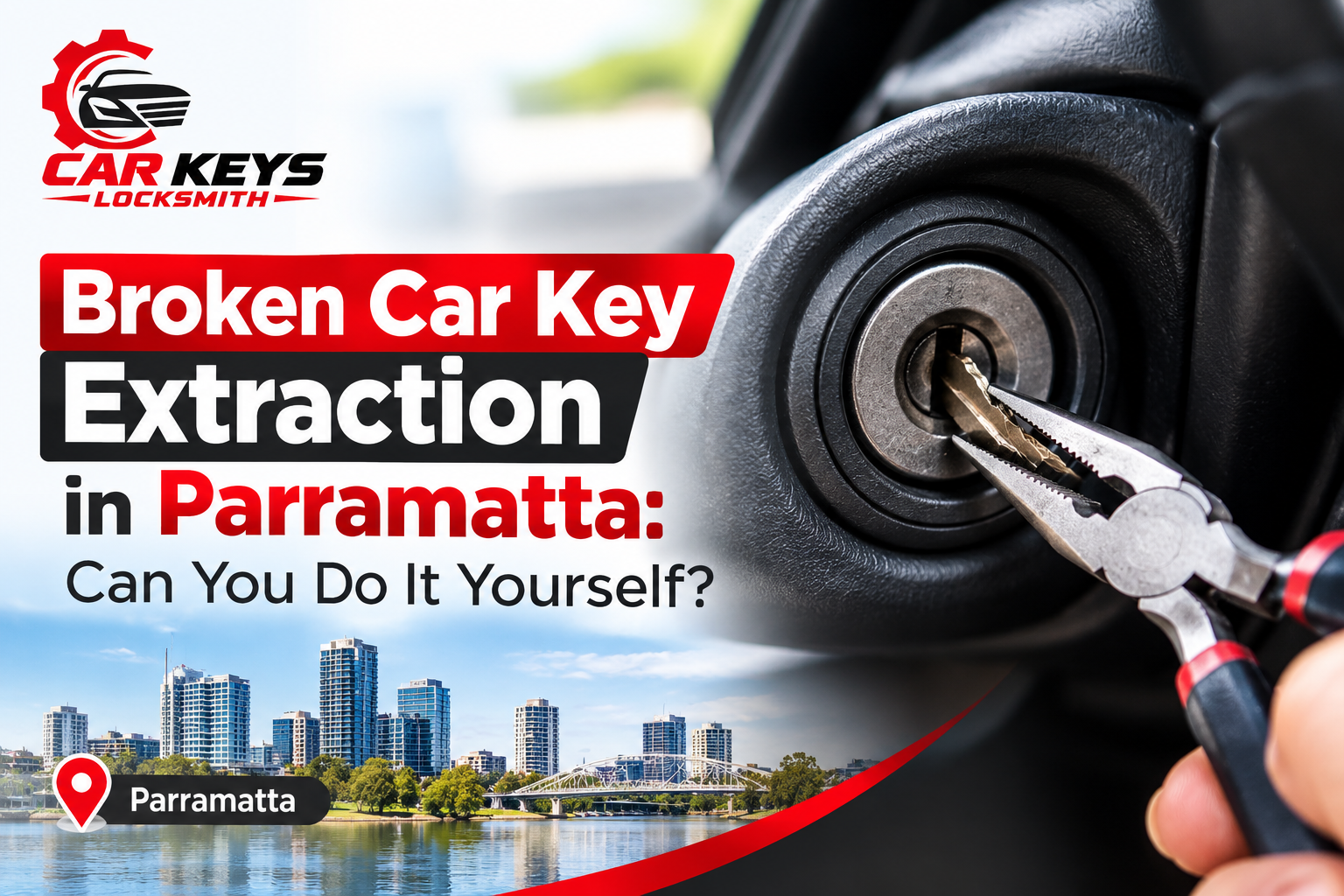
3. Pulling Too Hard With Pliers
Pliers can sometimes grip an exposed piece of metal, but they are not a reliable solution for every broken key.
If the fragment is small or positioned at an angle, excessive pressure can break it again or push it deeper into the cylinder.
Never force a fragment that refuses to move.
4. Trying to Turn the Ignition Again
If the key has snapped while turning the ignition, resist the urge to keep turning the remaining piece.
The ignition may already be under strain, and additional force could complicate the extraction process.
Leave the ignition alone until the broken fragment has been assessed.
5. Drilling Into the Lock
Drilling is not a suitable first response to a broken car key. It can damage the lock cylinder and potentially lead to further repairs or replacement.
A professional should assess the problem before any invasive work is considered.
What Should You Do Immediately After Your Key Snaps?
A few sensible steps can help protect your vehicle while you work out the next move.
First, stop using the lock. Do not push the remaining key into the opening or attempt to turn it again.
Second, check where the fragment is located. Is it inside the driver’s door, the boot or the ignition? This information will help you explain the problem when seeking assistance.
Third, keep the broken pieces. The remaining key head and metal blade may help identify the correct replacement. If the key contains a transponder chip, keep the electronic components safe as well.
Fourth, avoid improvised removal methods. Do not insert needles, paper clips, knives or other unsuitable objects into the keyway.
Finally, arrange help if the fragment is stuck. When contacting an automotive locksmith, provide your vehicle’s make, model and year, along with the location of the broken key.
These steps apply whether you are parked at home, near Parramatta CBD or in a local shopping centre car park.
If your vehicle is stopped in an unsafe location, move to a safe area if possible and prioritise your personal safety.
How Does Professional Car Key Extraction Work?
The removal process depends on the vehicle and the position of the broken key. A trained automotive locksmith can inspect the lock and choose a suitable method rather than relying on guesswork.
Step 1: Inspecting the Lock
The locksmith first examines the keyway and determines how the key has broken. They also check whether the fragment is accessible and whether there are signs of damage to the lock.
Step 2: Choosing the Appropriate Tool
Broken key extractors are designed to access and grip fragments that ordinary household tools may not reach effectively.
The correct tool depends on the lock design and the position of the broken piece.
Step 3: Removing the Fragment
The locksmith works to remove the remaining metal while minimising unnecessary pressure on the lock’s internal components.
Not every fragment comes out in the same way, so the technique must suit the situation.
Step 4: Checking the Lock
After removal, the lock may need to be inspected to determine whether it still operates correctly. If the key snapped because the ignition was stiff or the mechanism was damaged, further attention may be necessary.
Step 5: Discussing Replacement Options
If the original key cannot be used again, a replacement may be required. Depending on the vehicle, this could involve key cutting, transponder programming or a suitable replacement remote.
Extraction and replacement are separate services, so it is worth confirming what your particular situation requires.
Why Do Car Keys Break Inside the Ignition or Door Lock?
Car keys are designed for regular use, but they can weaken over time. Several factors may contribute to a broken key.
Everyday Wear
Repeated use can gradually wear down the metal blade. Small weaknesses may develop around narrow sections, particularly on older or heavily used keys.
Bent or Damaged Keys
A key that has been bent, dropped repeatedly or otherwise damaged may be more vulnerable to snapping.
A Stiff Ignition Barrel
If your key regularly resists turning, the problem may not be the key alone. Wear, contamination or a mechanical fault within the ignition can contribute to the resistance.
Excessive Pressure
Trying to force a key that will not turn normally places additional strain on the blade. This can cause it to snap at its weakest point.
Worn Door Lock Components
A faulty door lock can make inserting or turning the key difficult. If you notice the same problem repeatedly, have the mechanism checked rather than forcing the key.
Recognising these warning signs early may help prevent another broken key and an unexpected interruption to your day.
Will You Need a New Car Key After Extraction?
Not necessarily. The need for a replacement depends on the condition of the original key and the type of vehicle you drive.
If the blade has snapped, it may no longer be safe or practical to use. A replacement blade can sometimes be cut to suit the vehicle, but modern electronic keys may require additional steps.
For example, a transponder key communicates with the vehicle’s immobiliser system. A newly cut blade alone may not start the engine if the required electronic chip is missing or not programmed correctly.
Remote keys and smart-key systems may have their own compatibility and programming requirements.
After extraction, ask whether your existing key can be repaired or whether replacement is the more practical option. If the ignition or door lock was difficult to operate before the break, that issue should also be investigated.
Broken Car Key Extraction in Parramatta: When Should You Get Help?
The right time to contact a locksmith is when the key cannot be removed easily without force, particularly if it is stuck inside the ignition or the fragment is no longer visible.
For Parramatta motorists, professional assistance may be useful when a broken key prevents access to the vehicle or leaves the ignition unusable.
Car Keys Locksmith can be contacted to enquire about broken car key extraction and related automotive locksmith services in Parramatta. Before booking, confirm that the business can assist with your vehicle and location.
It is also sensible to ask about the call-out fee, estimated arrival time and likely cost before authorising work. The final price may depend on the vehicle, the difficulty of the extraction and whether a replacement key or additional repair is needed.
A broken key does not automatically mean you need a new ignition. In many cases, the first step is simply to assess the fragment and determine the safest way to remove it.
Final Thoughts
Trying to remove a broken car key yourself may seem like the quickest solution, but the wrong technique can make the problem worse. If a fragment is clearly accessible, gentle removal may be possible. If it is lodged inside the ignition or door lock, forcing it out is rarely worth the risk.
For anyone dealing with a broken key in Parramatta, the sensible approach is to stop using the damaged lock, keep the broken pieces and seek professional advice when the fragment cannot be removed easily.
Car Keys Locksmith is a point of contact for drivers who want to enquire about car key extraction, replacement keys and related automotive locksmith services.
The important thing is not to rush the process. Protecting the lock now may help you avoid more complicated repairs later.
Frequently Asked Questions
1. Can I extract a broken car key from the ignition myself?
It may be possible if part of the key is clearly exposed and can be removed without force. If the fragment is fully inside the ignition or will not move easily, stop and seek professional assistance.
2. How much does broken car key extraction cost in Parramatta?
The cost depends on the vehicle, the position of the fragment, the difficulty of removal and whether additional repairs or a replacement key are needed. Contact Car Keys Locksmith for a quote based on your circumstances.
3. Can a broken key damage my car’s ignition?
A broken key does not automatically mean the ignition is damaged. However, forcing the key or attempting removal with unsuitable tools can damage the lock cylinder and make the problem more complicated.
4. Will I need a replacement key after extraction?
You may need a replacement if the original blade is no longer usable. Depending on your vehicle, the replacement may also require transponder programming or remote-key configuration.
5. Can I contact Car Keys Locksmith for broken car key extraction in Parramatta?
You can contact Car Keys Locksmith to ask about availability for broken car key extraction in Parramatta. Explain where the key is stuck and provide your vehicle details so the business can assess whether it can assist.
Leave a Reply